
Part IV. Between the Ears:
Music For Its Own Sake
The word “analysis” easily associates itself in music with the idea of all that is dead, sterile, and farthest removed from the living work of art… namely—and I'm going to say something blasphemous here—its similarity to the jigsaw puzzle. -Theodor Adorno, On the Problem of Musical Analysis
I'm sure there are a lot of people in this [hockey arena] who do not know the difference between a blue line and a clothes line. It's irrelevant. It doesn't matter. -Al Michaels, introducing the Cold War gold medal hockey game between the USA and Soviet Union, aka The Miracle On Ice
Music is like sports. You don't necessarily need to know the rules to enjoy them. And even if you know the rules, some games might be boring anyway.
In other sections of this book we've said something to the tune of, “Here's what makes a game more exciting, or what makes one player especially fun to watch. With just a storyline, you can still get swept up in the emotional roller-coaster and feel your heart beat faster as time expires.”
But in every sport there are a few organizing principles—balls and strikes in baseball, the first down in (American) football, and yes, the blue line in hockey—that begin to zoom out the game to a higher level, unlocking the underlying chess match and revealing genius and strategy beneath the adrenaline and athletics.
In this section we'll do the same for pure music—music that exists only for its own sake. A few organizing principles, and we'll start to see the brilliance that has kept listeners coming back for centuries.
When I was in high school, my neighbor, the pianist Frederic Chiu, recommended a book to me: Gödel, Escher, Bach by Douglas Hofstadter, which explores the way the musical works of J.S. Bach and the art of M. C. Escher relate to the mathematics of Kurt Gödel.
 M. C. Escher's Drawing Hands
I hate to admit that in my first year with the book I only got through half of it, but a couple years later I was starting a Bachelor's degree on the same themes, a program called Symbolic Systems. The question that inspired me: “How does a system take on meaning that is more than the sum of its parts?”
In other words: How is it that a single sound, or letter, or word carries limited meaning by itself, but as you start to group more of them together, they start to take on meaning?
An ant by itself is helpless, but an ant colony is a highly efficient organism. A neuron by itself is dumb—but somehow you get billions of them together in the brain and you get consciousness.
And the one I'm leading up to: a single note or even a phrase of music by itself carries little meaning. But put them together—or even (as we will see) just layer the same one over itself several times—and we get music in all its glory: music that can change how you feel in that moment, music that can make your day, and music that can change your life.
Hofstadter's answer to this question? Self-reference. A few neurons don't do much on their own. But when billions of them work together, the brain eventually becomes complex enough to refer to itself. And once a system can do that, a sense of “I” begins to emerge.
Likewise, four notes of music might just be notes by themselves, but once the music starts referring back to that initial cell and developing it, you can get something as complex and emotional as the Funeral March from Beethoven that we just heard.
In this section, we will begin to look at purely abstract works—works titled Canon, Fugue, and Variations, and think about how to think about them. And I suspect we'll find that the intellectual treasures we find in these forms will apply more broadly to how we listen to other types of music, including the narrative music we heard in the previous section.
Canons
Canons are perhaps simultaneously the simplest and most complicated of musical forms. Many of us start our musical educations with a canon—something like "Row row row your boat" or Frère Jacques. One person starts singing the tune, then another person starts singing it a few bars later, creating a cool effect that breaks your brain a little bit the first time you try it. But let's be honest—that world-famous ditty about rowing your boat gently down the stream would not have risen to its place among the world's best-known tunes if it weren't sung in a canon. 💬
Self-reference is the point of the form: the music does what it just did. If one voice goes up, the next voice will go up too. And as one can expect, in the hands of someone like J.S. Bach, this cool little “Row Row Row Your Boat Effect” can be exploited in ways that give us works that break our brains more and more.
So here's a short canon from Bach's Goldberg Variations—first on multiple instruments, so it's easier to see what's happening, then on a single keyboard as Bach wrote it.
One violin plays the tune and then the other violin answers. The cello accompanies with a free bass line.
To write in such a strict form—the exact same music, transposed up a step, and delayed by a beat, and layered on top of each other—is doable with an algorithm. But to make it actually sound expressive after all that is art.
The interpretation chain no longer starts with something in the world, like Story > Composer > Performer, or if it does, the composer has deliberately obscured it from us. The piece is not named “Nutcracker,” but “Canon.” So how does a performer interpret a piece called “canon” with nothing else to go on—in the case of Bach, no tempo markings (speed), no dynamic markings (volume), no articulation markings (note length)? Our biggest clue to the “meaning” of the work is the word “canon” and the notes on the page.
Below are a few performances in the performance switcher, with all three voices played by a single keyboard player rather than by a string trio.
For Glenn Gould in this 1964 CBC Broadcast, the canon's leader is first among equals. You can still hear the voices formed by the two violins—both played in the right hand while the left hand runs free—but you would be forgiven for missing the interaction between them. 💬 The meaning of the canon is in the way the voices bounce off each other, playing with each other but not stopping to wave whenever they overlap. The structure gives a bubbly effect. Meanwhile, the bass line runs free from the structure, a contrast to the canonic voices in the right hand.
In Jean Rondeau's version for harpsichord, the original instrument the piece was composed for (the piano didn't exist yet), he lingers each time the voices come together, not unlike Gould does in his 1955 recording of the piece. One voice is yearning to catch up to the other, but never quite can until the end.
I also included an interpretation in the video switcher from a series I did playing Bach “for myself” late at night, in the spirit of the old legend that the Goldberg Variations were written to help Count Kaiserling fall asleep. It takes this lingering harpsichord effect to more of an extreme, emphasizing a bit of the dissonance where the voices overlap—a bit of pain or nostalgia. The voices here are in earnest communication with each other.
It's very tempting to ask—is the marvel of this music the mathematical wizardry of writing a canon with such a cool effect, or is it that Bach is able to put so much character and expression into such a strict form? And of course it's tempting to answer, “both, that's why Bach is so great.”
But this question would miss the point: the real marvel is that the form is inseparable from the expression. This chasing of one voice after the other, almost catching up but meeting just a half step apart, while the bass line roams free—shows us that the architecture of it all is itself poetic.
Next Level CanonsTap to expand your mind
In the canons of the Goldberg Variations, each subsequent canon separates the voices by more and more distance so that by the last one, a canon at the ninth, the leader voice and the follower voice sound are so far apart that they are just played by different hands without any bass line. You can see how you might listen to it as a game, following one voice chasing the other.
For Bach, intricate architecture enabled it to transcend being “just math” or “just music.” In his 2013 biography, Bach: Music in the Castle of Heaven, John Eliot Gardiner wrote, “Bach understood that the more perfectly a composition is realized, both conceptually and through performance, the more God is immanent in the music.” The Baroque era used the awe-inspiring to evoke appreciation and wonder—Bach's music was not unlike a cathedral in this way. Anywhere you look, there is a detail worth noticing, whether you look at the whole thing, one niche, or a tiny ornament. 💬
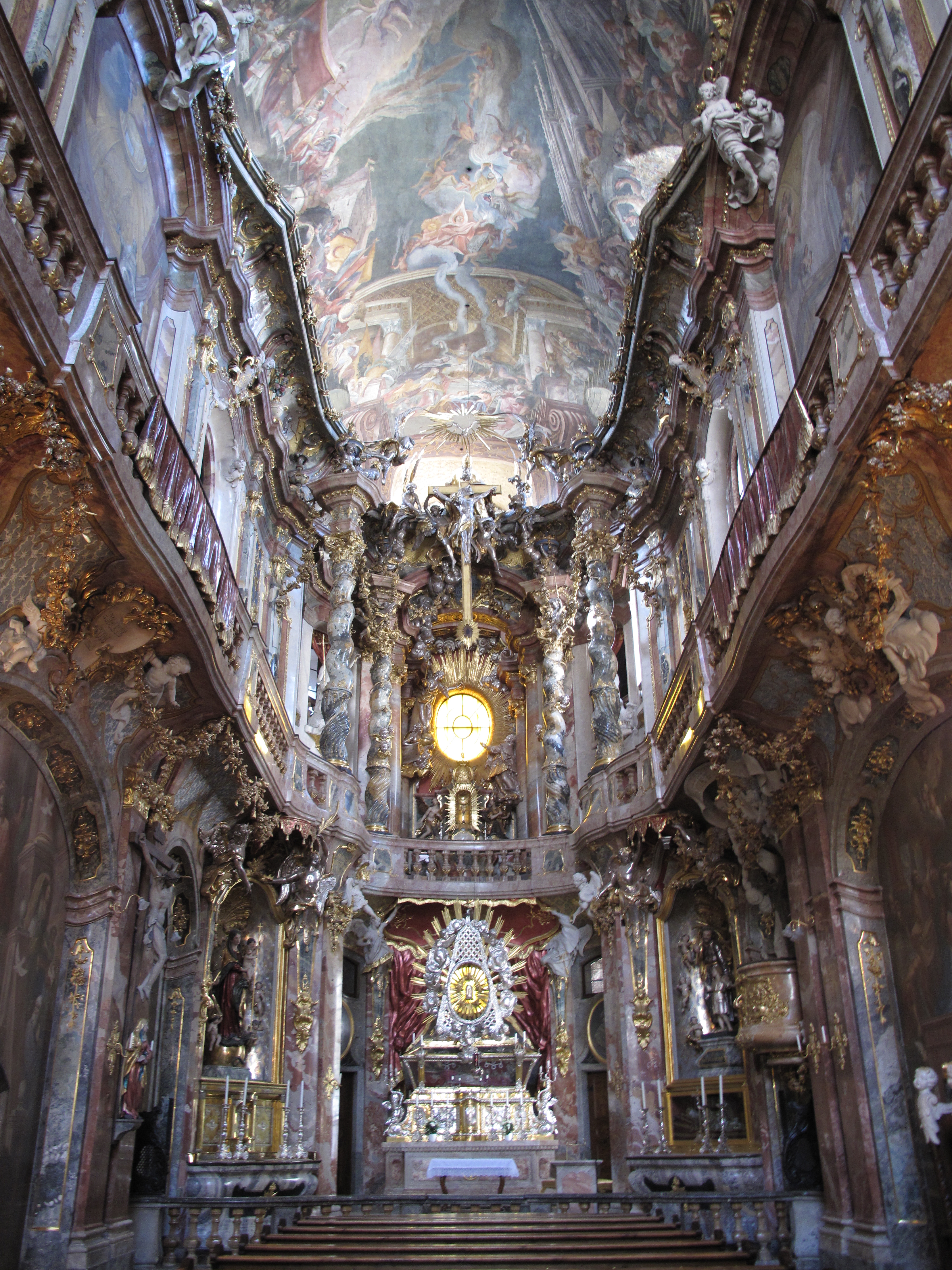 Interior of St. Johann Nepomuk (Asamkirche), Munich — Baroque detail and structure in the service of awe.
In fact, Bach's best canons use their structure to reach a poetry that could not be achieved any other way—a musical point that could only be made with a specific form. The mirror canon that closes the first half of the Goldberg Variations—the first of only three minor key sections out of thirty total—is one such a piece.
In the first voice, we get a downwards lament. The follower immediately echoes it by rising up to the heavens. And somehow the reflection gives it an entirely different meaning.
Each voice would be pretty on its own. But it's only in putting the two together—in holding the two simultaneously—that gives it an ethos that goes beyond many of the emotions we see in more programmatic music.
In the end, the voices continue in contrary motion, separate to their ends of the keyboard, as if they could go on in that direction forever. There are many things in life that this canon could be symbolic of, any number of yin-and-yang meditations it could represent. But to me, this form is such a pure statement of duality that I don't need to say it's about light and dark or life and death, just that it simply is is enough.
Holism, Reductionism, and Fugues
In listening to these examples, you likely experienced two different ways of interpreting and listening to these contrapuntal works with lots of different voices. You can either pick out and separate the individual lines, like the two violins, and follow them. Or you can just hear the combined sound, like stepping back and seeing the entire cathedral.
Listening to the individual parts is called reductionism. Listening to the bigger picture is called holism. It's nearly impossible to do both at once. In Gödel Escher Bach, Hofstadter's character Achilles instead chooses to say Mu—“a Zen idea that in this context means we should reject the assumption that we have to choose between holism and reductionism.”
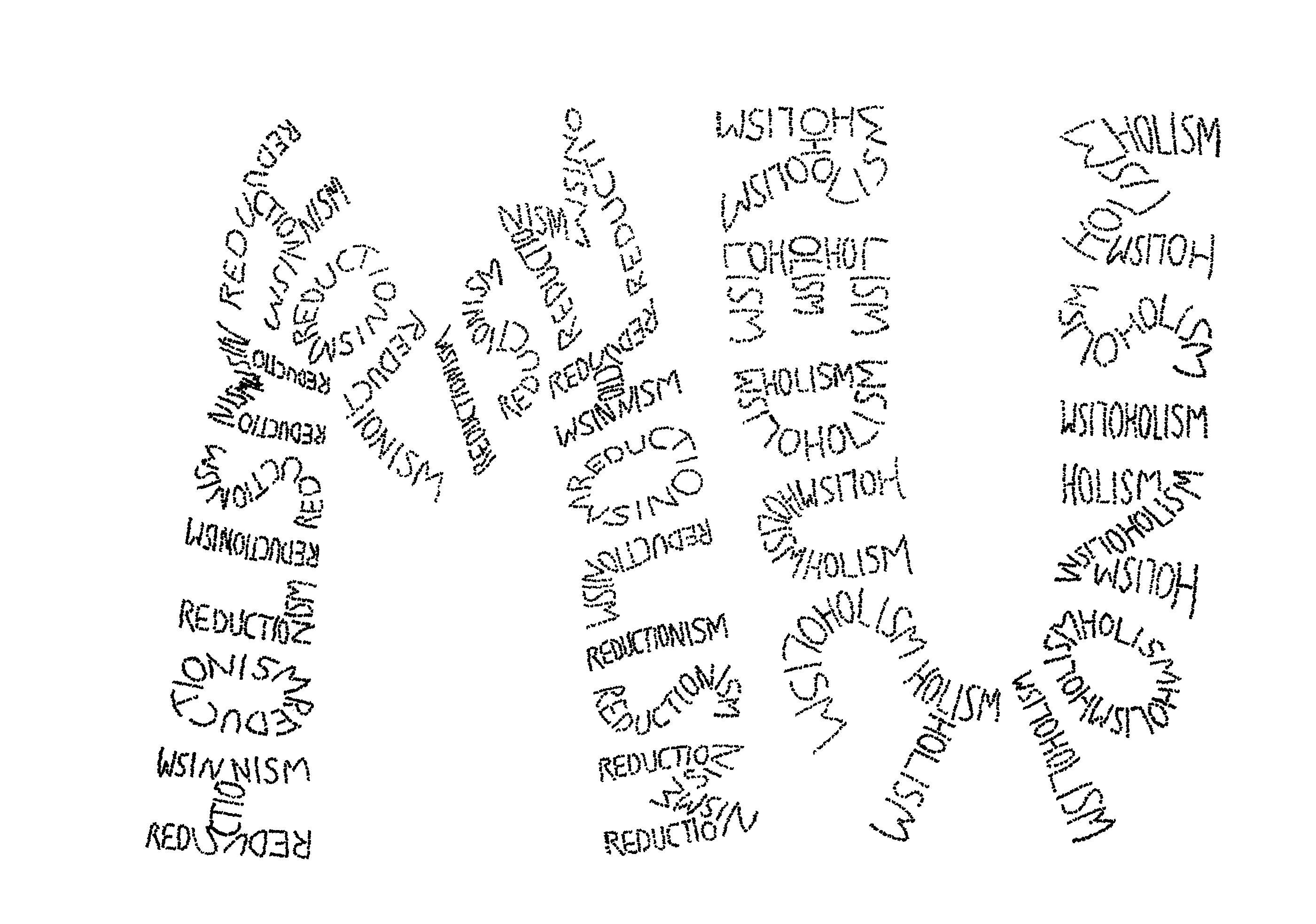 The big "M" is made up of the word "Holism" 3 times, whose characters are made up of the word "Reductionism", whose characters are in turn made up of the word "mu". In the "U", it's the opposite. (Image from Douglas Hofstadter's Gödel Escher Bach)
Having alternate approaches is one of the reasons that classical music does so well with repeated listens—you can always look at it a different way and find something new.
Let's take a look at a couple fugues with this lens. A fugue's defining feature is that it has a theme (or two or three) that is passed around from voice to voice. The opening exposition often sounds just like a canon—you hear the same melody from each voice in succession—but there is much more freedom in a fugue. After a voice plays the initial theme, there are no rules about having one voice strictly following another note by note.
We'll start this time with a vocal fugue, where each musical “voice” is literally a different voice. At the beginning, it's much easier to apply a reductionist approach, listening to every voice as it enters. By the end there is so much going on that it's extremely difficult to follow the individual vocal lines, especially in a first listen.
Here is a section from the B Minor Mass, "Cum sancto spiritu" (With the Holy Spirit). Every time you hear those words, it will be a new voice entering with the fugal theme, which is called the subject.
Stretto fugues—fugues where the entrances start layering on top of each other—naturally build in tension as more voices enter. And yet the amount of “melody” is so small—just a single theme that is repeated over and over again. Another case of self-reference giving greater meaning to a work: you could never have expected the full effect of multiple overlapping fugal lines from just hearing the theme by itself.
Once you start listening for this, you can hear it in lots of places, like the opening of the Mendelssohn Octet's finale—in which all eight players, from lowest to highest, take up the fugue subject more rapidly towards the end (a mini-stretto) before regrouping in unison. This is called a fugato—a fugal section of a larger work.
Or you might even find something like a fugato improvised on the spot in Nina Simone's “Love me or leave me”:
Fugatos abound in the repertoire—see the Rabbit Hole at the end of the chapter—without telling you what structure they will take. I remember conducting the Barber Adagio for Strings for the first time and realizing, "wow this is just a fugue and the climax is a stretto, I had no idea."
On the first listen, you might not even be able to tell whether something is a fugue or not, let alone hear all the entrances. Charles Rosen wrote, “A fugue of Bach can be fully understood only by the one who plays it, not only heard but felt through the muscles and nerves.”
Like the canon, fugues transform their theme in any number of ways—play it twice as fast or slow, play it upside down, backwards, both, etc. Bach's Art of Fugue, which consists of fourteen fugues and four canons, all based on the same principal subject, get so complex by the end that you have in one piece three fugue subjects alongside all of their transformations. In an ultimate moment of self-reference, Bach introduces his own name as a subject in the final fugue (B-A-C-H in the German note names translate to B-flat A C B-natural in the English note names)—and the fugue ends mid-phrase. The composer's son, Carl Philipp Emanuel writes below it, “Upon this fugue, where the name BACH was placed in the countersubject, the author died.”
When I was studying the 11th Contrapunctus, my teacher told me—I believe correctly—that nobody will be able to follow the individual transformations of the theme (reductionism), so it has to be played for the overall effect (holism). For years, some scholars even thought that Bach's Art of Fugue was only meant to be studied, not performed, since Bach never specified an instrument. Now it's performed by every instrument from pianists to the Swingle Singers, who inspired the Netherlands Bach Society.
But unlike the canon, which basically stopped when Bach died, fugues have been written ever since, in various styles and even with new complexities.
György Ligeti, who knew Hofstadter's work, started his etude “Autumn in Warsaw” with one of the simplest themes possible—four notes falling downwards, used throughout music as a lament. He sets this against a hypnotically pulsing background, that keeps the time for performer and audience: the lament theme falls down once for every five background notes.
Then, like a fugue, Ligeti starts bringing in the theme in more voices. He's not strict about the shape of the theme being the same—sometimes the lament will be only three notes, sometimes it will be extended far beyond that. But the key is that he changes their speed every time—what started as every five beats is sometimes shortened to three or extended to as much as nine, and sometimes variable.
When I perform this piece, people often say, “that must be impossible to memorize.” In fact, the first time I performed it in a competition, I lost my fingers and had a terrible memory slip—skipping almost an entire page by the time I recovered. After the competition, one jury member, who had the score in front of her, came up to me and said, “wow, I can't believe you memorized that so well!”
This is to say—it can be virtually impossible to follow some pieces on the first listen, even if you're a professional pianist looking at the music—but you can always fall back to listening to the holistic effect of all these harmonies coming together unexpectedly. And if you think that sounds like it would just dissolve into chaos—just wait till you see how it ends.
Sometimes this piece is called a “tempo fugue”—a fugue that is playing with time. If you think, “there's no way to keep that up, that piece must just dissolve into chaos”—here's the ending. This is the video that first compelled me to learn these pieces in the first place, and later to study with the pianist, Jeremy Denk.
Variations
If the fugue was one step less strict than the canon, then a few more steps less strict still would be the Theme and Variations. Like in almost all forms of music we've seen, we start with a theme, a single melody or cell from which the rest of the piece is spawned. But in a fugue, the transformations of the theme are typically limited to mathematical operations—slowed down, sped up, mirrored backwards, mirrored upside down, or a combination. Once you start doing more than that—varying the melody itself or its basic character, the work becomes a Theme and Variations.
If the central “listening” tension in the fugue is between reductionism and holism, clarity of texture in the midst of complexity at a given moment, the key tension of the variation form is a sort of reductionism vs holism across time. That is to say, the tension between the unity of the whole work, the “sameness” of hearing the same theme over and over again, against the atomization of variations, of each section being given a unique mood and character.
The large scale variation forms use this tension to create entire worlds and stories woven out of just a single musical idea.
A Familiar Theme
It is still a bit of a mystery to me why so many of my favorite pieces come from such a simple idea: take a tune and change it. But it does give you some insight into a composer's brilliance. Let's take a theme we all know:
It can be a humbling experience to think for a moment what you might do if you were to craft variations of this tune, being as creative as possible to try to come up with something interesting. Then we'll hear a bit of what Mozart does. (In fact, there's a scene in the movie Amadeus where Mozart humbles the composer Salieri in a similar way.)
As he progresses, Mozart stretches the recognizability of the tune to its breaking point—you might not even be able to hear the original tune anymore, but still it always sounds as if it's part of the same piece. If the variations were too similar, there's no way you'd be able to stay awake for twelve minutes of “Twinkle Twinkle Little Star” (after all, it's a lullaby designed to put babies to sleep). And if they are too disparate, the audience would not be able to follow at all.
This balancing act is not just on Mozart, but also on the performer to give each variation a distinct character while still showing the thread. I can't tell you how many student performances I've heard of variations that felt like slogging through concrete.
Here is pianist Elisabeth Brauss. Use the selector below to sample a few of the variations that Mozart writes.
Any of these variations by themselves would still be quite beautiful. They are fuller than a simple fugue theme. But they still would not be that notable by themselves. It is the self-reference—the way that they refer back to the main theme and build off of each other—that make them remarkable. And all these constant contrasts could have felt like emotional whiplash, but the theme keeps us grounded, a touchpoint to come back to.
But let's take that thought experiment from earlier a bit further—what if you asked yourself, what you could do with that same theme, but you happened to be a brilliant contemporary composer yourself, and had access to all the modern styles since Mozart? What would a different composer do to vary the same simple theme?
Here's Hayato Sumino's 7 Levels of Twinkle Twinkle Little Star, who begins his variations like Mozart, but then quickly takes off on his own. Again use the selector to sample the variations. I've put my favorite three first. Unlike Mozart, Sumino always keeps the main theme more or less unchanged, but there's so much inventiveness in the notes “around” the theme that the audience can't wait to hear what he'll do next.
Does the Theme Even Matter?
With such a wide range of transformation on a theme as banal as “Twinkle Twinkle,” it's a reasonable question to ask—does the theme even matter?
In 1819 the publisher Anton Diabelli sent a waltz to dozens of composers, including Schubert, Hummel, and Czerny to write a variation as an advertisement for his publishing house. Legend has it that Beethoven dismissed the theme as unworthy, but later changed his mind to prove a point, and turned Diabelli's theme, into not one but thirty-three variations including a fugue, called by pianist Alfred Brendel the greatest of all piano works (hyperbole for my taste, but many would agree with him). The variations from other composers are remembered primarily as a historical curiosity.
But then on the other hand, we have themes that composers can't help but write variations for. Nikolai Paganini's 24th Caprice for solo violin is one of the quintessential theme and variations. A theme so catchy that it's an earworm in itself—and simultaneously a simple enough cell that the possibilities are endless, regardless the composer or the style.
The theme is so “variationable” that composers from Johannes Brahms and Franz Liszt to Andrew Lloyd Webber and Benny Goodman have written variations of their own. In 2022, violinist Fenella Humphreys even recorded 12 newly commissioned micro-variations, each just 16 bars, with sub-titles ranging from Emily Howard's post-covid Lockdown to Seonaid Aitken's Gypsy Jazz. In many ways, this idea of a single theme, or “head,” followed by conversation about the theme is the basis for jazz.
My favorite of the Paganini variations is Rachmaninoff's Rhapsody on a Theme of Paganini, which uses the exact same theme, divided between the piano and the orchestra.
But the most memorable moment is when Rachmaninoff flips the theme upside down, dropping us into a different world completely. I have to admit that I didn't even realize that this is what Rachmaninoff was doing the first probably dozen times I heard the piece. The melody was too luscious to make me even ask how it was connected to the main theme—I just sort of trusted the composer that it was connected somehow.
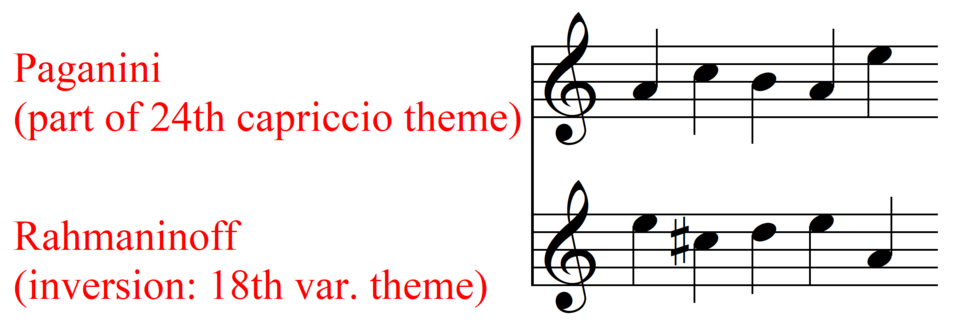 Even if you don't read music, you can tell that Paganini's theme is a mirror image of Rachmaninoff's
If you haven't noticed by now, the idea to invert the theme is a favorite device going back to the canons and fugues of Bach. What's amazing is how Rachmaninoff uses it to completely change the character of the music. The result couldn't be more “Rachmaninoff”—far removed from the violin's virtuoso showpiece, transformed into a sing-your-heart-out, can't-help-but-fall-in-love, soaring melody with more than a little bit of Hollywood. Commenting on this variation's appeal, Rachmaninoff said, “This one's for my agent.”
These are the types of moments that make the variation form special. As an audience member, you never in your wildest dreams would have listened to the original theme and imagined it transformed into this. Rachmaninoff did—but our primary impression isn't one of “wow he's a genius for coming up with that,” we are just swept up in the beauty of a complete transformation that we never saw coming.
Pocket Concert: The People United Will Never Be Defeated!Tap to expand
Very few great canons were written after 1750 when Bach died. Fugues remained more popular, especially as finales of symphonies, but were largely surpassed by the sonata and symphony in popularity. But variations never really wavered.
Variation form has storytelling built in, not unlike a movie soundtrack which treats its main theme differently every time depending on the situation it comes back.
In the next chapter we'll take one step further towards “free” development of a theme and look at sonatas and symphonies.
The Rabbit HoleMy listening recommendations
There's a ton of music to recommend here, so I'll try to organize it for easy perusal.
Canons, as we discussed, sort of begin and end with the canons of Bach—the Goldbergs' Canon at the 7th is my personal favorite—but there are some others to point out as well. Schumann wrote canonic etudes for the pedal piano, a very cool piano-organ sort of a hybrid instrument.
Comments & Discussion