
The Most Underrated Movement: Scherzos, Jokes, and “Jokes”
[Haydn has] a sort of innocent mischievousness, or what the British call humour. -Georg August Griesinger, a biographer of Haydn †
The problem with the comical is that it can be perceived very differently—or not at all. Music has been granted the ability to sigh but not to laugh. Some people deem themselves to be above laughter and consider earnestness a proof of human maturity. -Alfred Brendel, A Pianist's A-Z †
So much ink is spilled about the first two movements of a sonata that by the time we get to the “optional” third movement, the minuet or scherzo, it's often written off as a “palate cleanser,” even in the most profound of pieces.💬
But this movement has grown up over the years. At the beginning, it wasn't even included at all, with pieces going directly from the slow movement to the finale. Then it was included as a light, simple dance, a minuet. Then it added more and more substance, until it transformed into a faster, more vigorous scherzo, meaning “joke”.
That gives it a unique place in the standard four-movement form. An almost programmatic title in the midst of three movements of absolute music. The interpretation chain would look something like:
Composer's Joke > Performers > Audience
Except that as often as not, the scherzo hardly jokes at all anymore—it's just the title given to the form.
In this chapter, we'll use the Scherzo as an entry point to humor in music, how it makes us smile, and when it doesn't at all.
But first, I think a whirlwind tour is the perfect way to experience the scherzo. Here are some pieces along the spectrum from a light minuet to intense drama.
Whirlwind Tour
We start with the scherzo's origins as a minuet—a ballroom dance. In the Baroque era, it was a part of a suite—here from Handel's Water Music. Here's the opening minuet.
I say the opening minuet because there are two minuets in most Baroque suites. We hear the first one, then the second one, then the first one again.
In that way, it's a bit like the ABA form that we saw in slow movements. The main difference is that usually in a slow movement, the outer A sections will be calmer and the middle section will be more dramatic. In a minuet or scherzo, usually the outer sections are faster, and the middle section—sometimes called a trio—will be slower.
Next here's a minuet from classical music's premier practical jokester, Franz Joseph Haydn. This is from his Symphony No. 65—start tapping your foot on the beat.
Sometimes, the Minuet is swapped for a different kind of dance more fitting to the particular symphony. In Florence Price's 1st Symphony, the Juba:
In the quartets of Debussy and Ravel, we have a Scherzo instead of a Minuet, which takes on a sort of light magic. Not laugh-out-loud funny, but good-natured. Still dance-inspired but not its primary quality.
Here is a bit of the scherzo from Kevin Puts' futuristic Contact, written for the “Time for Three” trio. Puts suggests the image of radio waves being sent into space looking for extraterrestrial contact—but somehow it's just pure fun to play and listen to.
Let's continue across the spectrum from light to intense with the hard-rocking scherzo from Lera Auerbach's cello sonata:
And now some Beethoven. There is still some wit in the way the “Harp” quartet parodies the fifth symphony. But there is also no lack of drive and intensity:
And as we arrive at the massive scherzo from Bruckner 9, we are now far removed from the minuets of Haydn:
But even Bruckner still finds some moments of the scherzo's original light-dancey quality towards the end of that excerpt. We'll finish with Brahms' 2nd Piano Concerto, what he called a “little wisp of a scherzo” (spoiler… it's not):
Jeremy Denk writes about this movement, “The dances have been given steroids. The act of play gets heavy.”†
Humor
As we said, scherzo means joke. But lots of pieces called jokes are not funny. Many of Dvořák's Humoresques are so beautiful they'll make you cry, but not laugh. Alfred Brendel wrote,
I own a cartoon from Czechoslovakia. In it a pianist is shown sitting on a concert platform. But instead of performing the piece on the music stand in front of him, he is helpless with laughter. The composition that provokes his amusement bears the title 'A. Dvořák—Humoresk'. In the cartoon the faces of the audience are all completely serious; they appear quite unmoved by the mirth of the pianist, who must surely have been the first to discover that Dvořák's Humoresque should be a matter of laughter.
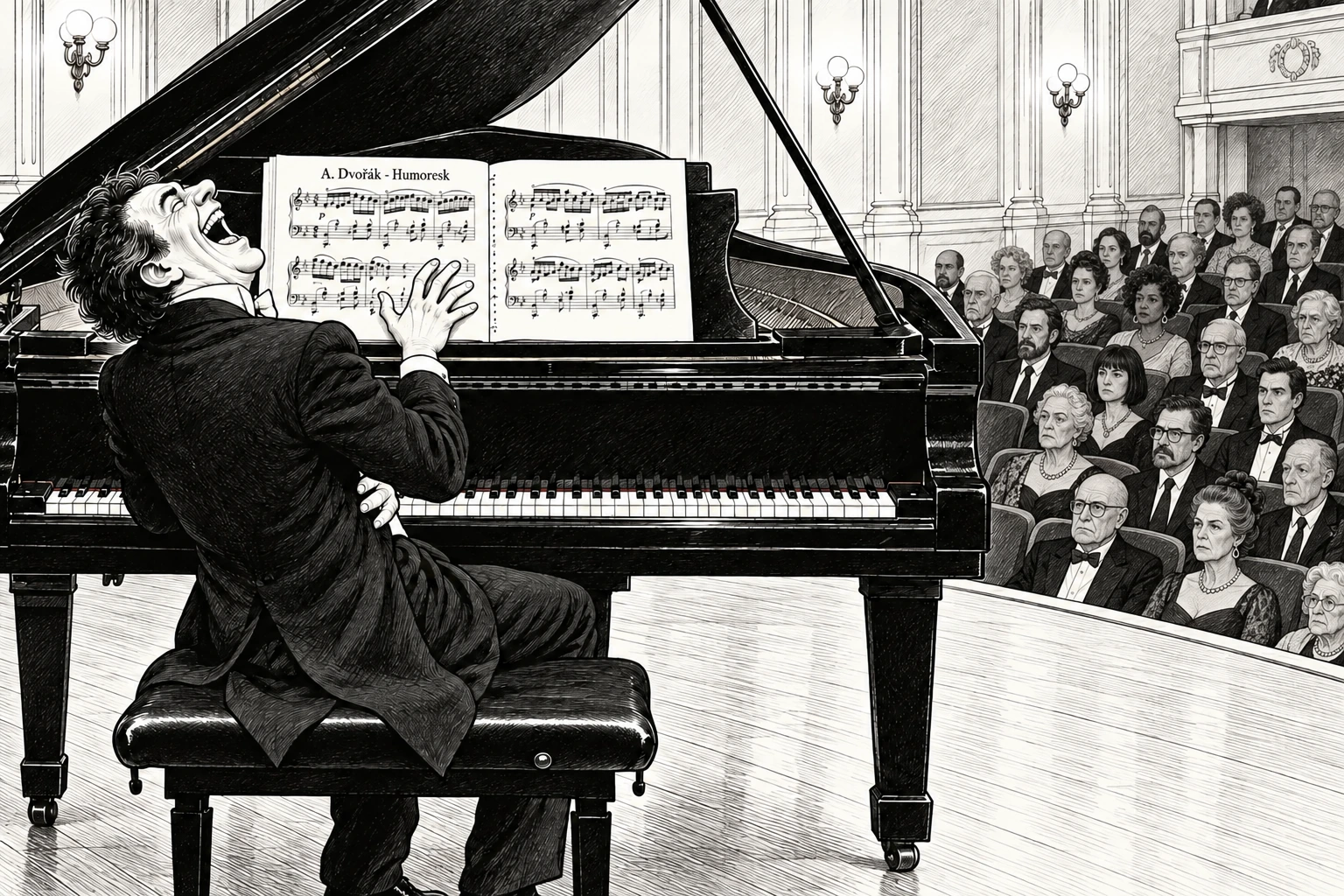 A pianist helpless with laughter before a solemn audience. AI-generated recreation from Brendel's description.
It's gorgeous. But it's not funny, and I want to start with the pieces that are more clearly jokes. And as in other chapters, we'll take a look at pieces not dubbed “scherzo” that can be viewed through the lens of comedy.
Punch Lines
Haydn intends “to lure the listener into the highest degree of the comical by frivolous twists and turns of the seemingly serious,” wrote Griesinger.
Like we just saw in Symphony No. 65's Menuetto, he sets up the listener's expectations—and then shatters them as he delivers his punchline. In this way, Haydn's humor resembles a regular joke.
The listener isn't just a receiver at the end of the interpretation chain, but actually a participant in the joke.
But this humor can be found outside of movements titled “Joke.” Take the finale of Haydn's “Jack-in-the-Box” string quartet, Op. 76 No. 1, whose carnival-esque music winds up like a jack-in-the-box before hitting a good-natured jump scare:
Maybe explaining the prank in advance takes some of the sting out of it. Still, you'll probably hear some chuckles in the concert hall, but not any loud guffaws.
I always wonder if it's because 1) It's only moderately funny, 2) Haydn wasn't going for a big laugh, or 3) our tastes in humor have changed, the way we—and especially children—can still identify and laugh at slapstick in old films but it's no longer the mainstream sense of humor.
Maybe it's some combination of the three. But Haydn certainly went bigger and wilder than this, with musicians tuning their instruments in the middle of the piece, bassoon fart jokes, false endings and sudden silences, and even musicians walking offstage to say they wanted to finish their summer retreat and go home now.
Nobody has really written jokes quite like Haydn in the years since.
Occasionally you'll hear something like Ligeti's absurdist Symphonic Poem for 100 Metronomes, or Nouvelles Aventures, theatrical comedy as musical comedy in which Ligeti invents a grammelot-esque gibberish language like something you'd see in a Cirque du Soleil circus act.
Meta-humor: jokes about musicTap to expand
Ligeti excelled at a special brand of humor of composers making jokes about musicians.
One especially fun piece of his to play is his Étude Touches bloquées, Blocked Keys. In this piece, one hand holds some keys down silently, while the other hand plays scales on top of them, tripping over the held notes. Meanwhile, the hand holding the keys down with some fingers uses its remaining fingers to poke out in mockery of the other hand. Almost like a real-life Tom and Jerry cartoon with Tom in one hand and Jerry in the other. Finally, the pianist decides to practice octaves and chords instead, but Ligeti inserts wrong notes to make the audience think the pianist just stinks… I've always wondered if it mattered whether I played the right wrong notes in that passage. Ligeti described it as circus clowns pretending to be unable to do a trick they can really do quite easily.
The Non-Scherzo Joke
In the pieces we've seen so far, the composer's intention is crystal clear. But the performer's delivery can fluctuate quite a bit—some will resonate with audiences more than others. And sometimes, the composer doesn't write “scherzo” to tell us a joke is coming.
I've heard many masterclasses on the opening of Haydn's C Major Sonata Hob. 50. Every single one has started, “it should be funnier.”
Here András Schiff plays it on the fortepiano—a forebear of the modern piano that was used in Haydn's time.
Schiff pulls out all the stops in his performance—from a one-finger technique to start (which always reminds me of Kit Armstrong's “The Buffoons”) to his mock-serious facial expressions (which remind me of Bernstein conducting Haydn with his eyebrows).💬
Certainly, listeners' tastes are quite varied when it comes to humor—even modern day stand-up comics are divisive. But I think the biggest factor in reception is the concert hall—an atmosphere that cultivates awe and respect, but doesn't prime people to laugh.
The thing is, you don't actually have to laugh to find something funny—like watching a cartoon in the moments in between the jokes when you're still smiling even though there's not a one-liner.
And although jokes can be found here and there in the classical repertoire, wit is inescapable, especially in the classical era music of Haydn, Mozart and Beethoven.
Here's a bit of Mozart's Piano Concerto No. 22 played by Yunchan Lim. The third movement starts by giving us the main tune for the dance:
A whistle-as-you-work kind of a jaunt, lighthearted, written with a smile.
This is a rondo form, meaning the tune will come back over and over again—we'll see more of this in the next chapter. Each time the theme is just about to come back, Lim (and Mozart) take our expectations and give us little surprises. They know that we're ready to hear that tune and do just enough to play with it—not exactly a practical joke a la Haydn, just changing a few notes here and there to keep us on our toes.
It happens a little differently every time—in fact if you don't know the piece, you might wonder if all the little embellishments on the theme were made up by Lim or by Mozart.
In the end, we have the soloist's cadenza—in Mozart's time, fully improvised.📖 But the orchestra has to know when to come back in, and the audience sees the orchestra waiting and ready. And so Lim uses this opportunity for a little more play since we all know what's coming next, we just don't know when:
As we discussed in the opera chapter, Mozart's music is always operatic. Mozart's wit is theatrical in a sense—you can imagine a silly Papageno-esque character as the protagonist interacting with the other cast members.
Beethoven, the Angry
On the other hand, audiences expect Beethoven to be firmly less funny than Mozart, and are primed for anger and intensity: a future branding problem he never could have seen coming—context firmly out of his control at this point.
Music teachers and program notes can't stop talking about how his witty side is just as prominent as his anger in his oeuvre, from his early Haydn-esque scherzi (Haydn was Beethoven's teacher, after all) to music that no one else could have written. Unfortunately, brands sell—so it's up to individual listeners to decide to listen based on how the music sounds.
Here's a bit of the second movement of his Op. 78 Sonata, from his middle period after he had begun to take his own path from Haydn:
I love playing this piece—partly because that alternating-hand two-note technique is super fun 💬—but also partly because it feels like laughing in music.
It's not quite onomatopoeic—I don't think Beethoven was trying to mimic laughter exactly. But his classic contrasts between soft and loud, emphatic and lyrical, that are used in the more “stereotypical angry Beethoven” music for dramatic effect, are still used here, but somehow achieve comedy instead of tragedy. The rapid changes in character and mood are less scary and more just funny.
As we get further away from punch-line jokes, we add the dimension of storytelling, not unlike what we've seen in previous chapters.
Richard Strauss is kind enough to give us a program right in the title of “Till Eulenspiegel's Merry Pranks,” alerting everyone that we're in for a fun romp about a prankster. It would probably work well as a cartoon soundtrack—and it prioritizes storytelling that's as thrilling as it is funny.
A piece called scherzo is not as programmatic—as we've seen, plenty aren't funny at all—but it can still hint at a programmatic interpretation, should we choose one.
Take for instance, the scherzo from Beethoven's Op. 130 String Quartet. The scherzo is still under 2 minutes long, but it offers enough contrast to create a world of its own. Here is one artist's imagination which reconciles Beethoven's rapid mood-shifts into a story:
This interpretation shows us that even if we hear a storm in the music, it doesn't mean that it's some existential conflict. It could also be a storm in a cute cartoon about bugs where they invent umbrellas to keep dry. The stormy music can be both honest and also not that big a deal.
Of course, this same music can be interpreted many different ways—the LA Philharmonic's program notes call it “a fleet whisper of a ghost dance.” And would it reset our interpretation to find the simpler charm of the movement that follows, marked poco scherzoso—“kinda joking?”
Sarcasm
There is even more room for ambiguity of interpretation when it comes to sarcasm in music (as in language). And like the “stretching a rubber band” style of slow movement, the sarcastic scherzo is a specialty of the Russian composers Prokofiev and Shostakovich.
Much of it is innocent enough by today's standards—Prokofiev's first symphony in the style of Haydn but with some wrong notes, for instance, or a jump scare of wrong notes in the Shostakovich piano concerto while the strings bounced their bows on the wood side of the bow (teenage me loved this part, in which my goal was to blow off the eardrums of the first violins, even though I could barely play the rest of the piece). Honestly, these are things Haydn might have done himself if he were born a couple centuries later.
But especially for Prokofiev, these wrong notes got wronger and intentionally more provocative, and he leaned in to his reputation as the bad boy of classical music.
He titled early pieces “Sarcasms” and “Diabolic Suggestion” and started to approach grotesquerie, clusters of indiscernible notes becoming subservient to raw rhythms. Beauty of sound was traded in for energy. From these programmatic pieces, we can see exactly what “wit” meant to him:
People who just write off Prokofiev as ugly aren't actually asking what he's trying to say. The music is often ugly! The problem is assuming that that means it's bad art.
We can see that same provocation in his non-programmatic pieces, both scherzos and otherwise. Prokofiev's second piano concerto (scherzo here) even incited an uproar—“To hell with this futuristic music! The cats on the roof make better music!”† But it's actually the third movement “Intermezzo”—which sounds like it would be the slow movement—that actually showcases the most sarcastic sense of humor.
The pianist's glissandi (sliding the hand over the keyboard in imitation of the flutes) turn into little sneers and jabs. It's up to the pianist and listener to decide if these little sneers and jabs are done with a mock seriousness, true maliciousness, or a lightly teasing smile.
Then as the fourth movement starts with his signature raw intensity, there are still moments when you doubt whether he's completely serious.
Even in the stormiest of movements, there are bits of playful irony. But these playful bits live alongside the overall impression of the Allegro tempestoso that Prokofiev asked for—fast and tempestuous. One of the most memorable performances I've seen was with piano student Jiaqing Luo at the PianoTexas festival, in which the power went out completely and thunder cracked right overhead competing with the orchestra at these stormiest of passages.
Politics and Secret Messages
Beyond Prokofiev's modernist proclivity which Shostakovich shared, Soviet politics also forced some irony and satire—often hidden—into their works. After Shostakovich received a bad review from Stalin's official newspaper, Pravda (meaning “Truth”), Shostakovich became a marked man. The review, titled “Muddle Instead of Music,” called Lady Macbeth of Mtsensk “coarse, primitive and vulgar,” and “chaos instead of music.” He was declared “formalist,” for music that was too complex for mass audiences, and started sleeping in the hallway with a packed suitcase so that when the secret police came, they wouldn't wake his family.
Nearly two years later, Shostakovich's Fifth Symphony premiered, subtitled “a Soviet artist's creative response to just criticism.”
The question that is always asked is whether the finale is triumphant or satirically triumphant, a sort of forced rejoicing. This is a question posed both to the conductor and to the listener, both of whom must make up their minds for themselves.
Below is the finale, in two versions, at vastly different tempi (speeds). You'll see differences even at the beginning, but the end is even more controversial, where the tempos are off by literally 2x. 📖
As you know, I don't usually like to delve into the history of a piece because I find that it usually strips out ambiguity; here, though, I feel like this little peek at the history highlights the choices for the listener.
Even if historians feel like there is a correct answer to this particular debate, musicians and listeners can still differ on how they prefer to hear the music. And if it is indeed forced rejoicing, it was at least hidden well enough that Soviet authorities didn't catch it.
I want to close this section by moving from Shostakovich's 5th symphony to Prokofiev's 5th, and offering a selection without the piece's background story. We can decide for ourselves what is satire or anger, what is good-spirited or mean-spirited, and ultimately, what message we receive from Prokofiev.
First, an excerpt from the scherzo, and then one from the finale labeled Allegro giocoso, fast and jocular.
And now the finale:
There is enough similarity between them that I'm glad the actual piece has a contrasting slow movement in between.
It's interesting to me that Prokofiev gives us two different movements in such similar styles—we have to assume he has a purpose and they're not just supposed to be identical.
Aside from the “jocular” finale's Hollywood-esque melodies, I personally find its sarcasm to be even more biting than the scherzo.
Today, the dissonance of this music remains difficult, but in different ways. Prokofiev might be pleased to find that listeners still find it sounds too modern, distasteful, barely “art”—his punches still land.
On the other hand, he might find that modern sensibilities have caught up to him—some listeners have become desensitized to sounds that were once ugly and provocative since they are now everywhere, especially in TV and movie soundtracks.
Regardless, the way we relate to his music will continue to change as the years do, but many of us find that his music still speaks to us today, even though we no longer live under the same dangerous totalitarian.
In a classic pattern, the composers that were once derided as too countercultural, too ugly, too “formalist” were later co-opted by the government, and this symphony was awarded the Stalin Prize.†
In an irony fit for one of his scherzos, Prokofiev met his own end on March 5, 1953, but it went unreported for days, and no flowers were available at his funeral. Stalin had died the same day.
Scherzo Magic: The Pocket ConcertChopin and Mendelssohn
I think we've progressed successfully to the other end of the scherzo spectrum—music that isn't funny at all. Let's look no further at the tragic, though, and instead turn our ears to the magical.
Scherzi-in-name-only
We'll finish by zooming back out to the whole piece, and the place of the scherzo in the whole. The scherzo is usually a small middle movement—buried second or third in a four-movement work. Why even include such a small, wispy inner movement?
For one, it sets us up to be blown away by the scale of a big finish. But then, you get the pieces like Brahms's “little wisp of a scherzo” from the Whirlwind Tour that are anything but—and the “hard rock” scherzos of Bartók that seem to have traded in sarcasm for screamo.
These scherzi-in-name-only can be the most memorable part of a full piece. They don't require a new type of listening—and they don't particularly offer a new lens—you can make sense of them as a film score, or a ballade, or a tone poem. But as they grow, they also contribute more and more to the gestalt of the whole work. In some pieces, the scherzo could even be the finale.
Here, a Tchaikovsky scherzo starts like a nice, fleet-of-foot, classic scherzo with just a hint of a march in the distance:
But ends in true finale style, the march having arrived:
Oh, what, the piece isn't over? Audiences always think this is the ending and applaud, but Tchaikovsky 6 actually has another movement—a slow movement—for a finale.
In the next and final chapter of this section on Symphony and Sonata form, we'll look at how an ending is earned and how a full, multi-movement work becomes more than the sum of its parts.
As always, the rabbit hole is below.
The Rabbit HoleTap for the superlatives
Same game as the symphonies chapter: superlatives, one composer each. Can't be one of the pieces we already heard.
- Most Haydn-esque: I kind of think that in Beethoven's Piano Sonata Op. 10 No. 3, he practically outdoes Haydn with his comedic timing and good-natured interjections. A favorite from my repertoire.
- Most difficult-sounding: Prokofiev Violin Concerto No. 1—I don't play violin, so I have no idea just how hard all these non-traditional techniques (left-hand pizzicato, bowing on the fingerboard, artificial harmonics) actually are to play, but as a “foreign” listener, this one gets my nod.
- Most moving: Handel Minuet in G (arr. Wilhelm Kempff) — an early baroque minuet (a precursor to the scherzo) now often played as an encore in Kempff's piano arrangement. A case of just pure beauty in the form.
- Best encore: Wieniawski Scherzo-Tarantelle — an effective showpiece for violinist prodigies of all ages.
- Most underrated: Farrenc Symphony No. 3—starting to get some more love, but still underplayed. This scherzo feels to me on par with the great Dvořák scherzi.
- Most monumental: Bruckner Symphony No. 7 — hard to pick a Bruckner scherzo—Bruckner is famously massive and his compositions can be hard to get into, but his scherzos are the best place to start.
- Most colorful: Ravel Piano Trio—I still remember hearing my cello teacher perform this when I was a teenager. I asked both my piano and cello teachers if I could play it. I could not.
- Most sardonic: Mahler Symphony No. 6 — Mahler marks the scherzo Wuchtig (heavy): a scherzo that stomps instead of dances. The Russians don't have a monopoly on sarcasm.
- Coolest innovation: Ives Hawthorne from the Concord Sonata — in which the pianist uses a plank to press down a whole cluster of keys for this somehow-beautiful slower section of the scherzo representing Nathaniel Hawthorne.
- Most notorious rite of passage: Franck Violin Sonata — for both violinist and pianist there are many pieces that are more “difficult” per se, but this piece is a rite of passage for most conservatory pianists as much as for violinists. Franck had giant meat hooks for hands, and the pianist slaves away behind the violinist trying to stretch their hands or frantically redistribute the notes.
- Best standalone scherzo: Chopin Scherzo No. 4 in E Major — the one Chopin scherzo that feels like it could actually be joking.
- Best “serious” scherzo: Has to be Brahms. I'll go for the Piano Quintet in a three-way toss-up with the Brahms 3rd Piano Sonata and the Andantino from the Clarinet Quintet, which buries the scherzo within a gentle intermezzo. But you could also happily call in a Brahms Piano Trio, or Piano Quartet, or Violin Sonata, or Symphony or… Not to mention the scherzo from the F-A-E sonata (Frei aber einsam, free but lonely), written with Robert Schumann and Schumann's student Dietrich. He did write explicitly joking music, like the Allegro giocoso, fast and jocular, but he really excelled in the “serious” genre.