
Part IV. Between the Ears:
Music For Its Own Sake
The word “analysis” easily associates itself in music with the idea of all that is dead, sterile, and farthest removed from the living work of art… namely—and I'm going to say something blasphemous here—its similarity to the jigsaw puzzle. -Theodor Adorno, On the Problem of Musical Analysis
Baseball is 90 percent mental. The other half is physical. -Yogi Berra
Music is like sports. You don't necessarily need to know the rules to enjoy them. And even if you know the rules, some games might be boring anyway.
But in every sport there are a few organizing principles—balls and strikes in baseball, the first down in (American) football, etc.—that begin to zoom out the game to a higher level, revealing the 90% of the game that is genius and strategy beneath the half that's adrenaline and athletics.
In Part IV, we'll do the same for absolute music. These pieces, called Fugue or Variations or Symphony, point primarily to their organizing principles—ideas that not only open our hearts but blow our minds.
The interpretation chain looks like:
Abstract form > Composer > Performers > Listener
Canons
The canon is somehow both the simplest and the most complicated of musical forms: one voice presents a tune, and then another starts singing it a few bars later, creating the “Row Row Row Your Boat” effect that breaks your brain a little bit the first time you try it.
Let's be honest—it's not the lyrics that make this ditty world famous; it's the canon that makes it fun. The voices in the canon chase each other like the hands of M. C. Escher drawing each other.📖
 M. C. Escher's Drawing Hands
When I was in high school, my neighbor, the pianist Frederic Chiu, recommended a book: Douglas Hofstadter's Gödel, Escher, Bach, which compares the music of Bach with the drawings of Escher and the mathematics of Kurt Gödel.
The main question is, “How does a system take on meaning that is more than the sum of its parts?”
An ant by itself is helpless, but an ant colony is a highly efficient organism. A neuron by itself is dumb—but somehow you get billions of them together in the brain and, ta-da, consciousness!
And the one I'm leading up to: an abstract phrase of music by itself carries little meaning. But put several together—or even (as in Row Row Row Your Boat) just layer the same theme over itself several times—and we get music in all its glory.
Hofstadter's explanation? Self-reference.
The canon is self-reference at its strictest. If one voice goes up, the next voice will go up too. Voice 2 does exactly what voice 1 did. Voice 3 follows Voice 2, in a loop, forever and ever until someone decides it's enough.
You can hear this with a bit more sophistication in the Franck Violin Sonata, where the canon puts violin and piano in lockstep. Whatever the piano's right hand does, the violin follows.
The conversation between the instruments feels so natural that you might not even realize they were just playing the same notes as each other.
Even if you're not following the canon, listening to the piano (the leader) and predicting what the violin (the follower) is going to do, there's a feeling of perfect inevitability: it could only be this way. M. C. Escher's hands could only draw each other; there's no breaking the loop of self-reference.
It's so comfortable—has a certain rightness—you might even think it was written for a newly married couple.💬 You could give this movement a programmatic title, like “Wedding Song,” or leave it as pure, and you'd arrive in the same place. The sentiment is inextricable from the form.
Next Level Canons 🤯Bach, The Goldberg Variations, and More
As you might expect, this only scratches the surface of what is possible.
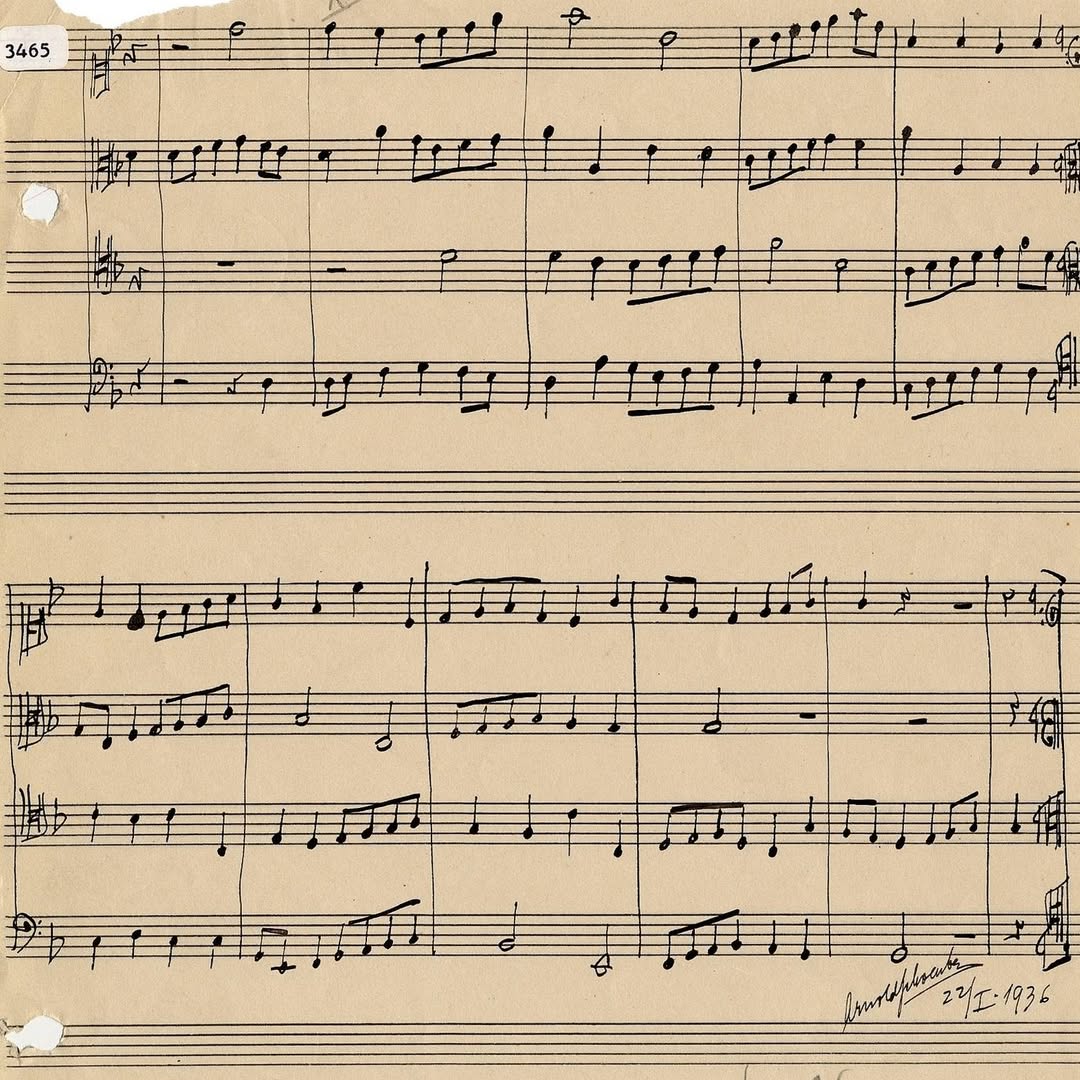
Here's a short canon from Bach's Goldberg Variations—first on multiple instruments, so it's easier to see what's happening, then on a single keyboard as Bach wrote it.
One violin leads and the other violin follows—but one step higher than the leader, meeting with a tinge of dissonance. (The cello accompanies with a free bass line.)
For Bach, working within a strict, intricate architecture was more than “just math” or “just music.” In Bach: Music in the Castle of Heaven, John Eliot Gardiner wrote that for Bach, “the more perfectly a composition is realized… the more God is immanent in the music.”
Bach's music was not unlike a Baroque cathedral in this way. Anywhere you look, there is a detail worth noticing, whether you look at the whole thing, one niche, or a tiny ornament. †
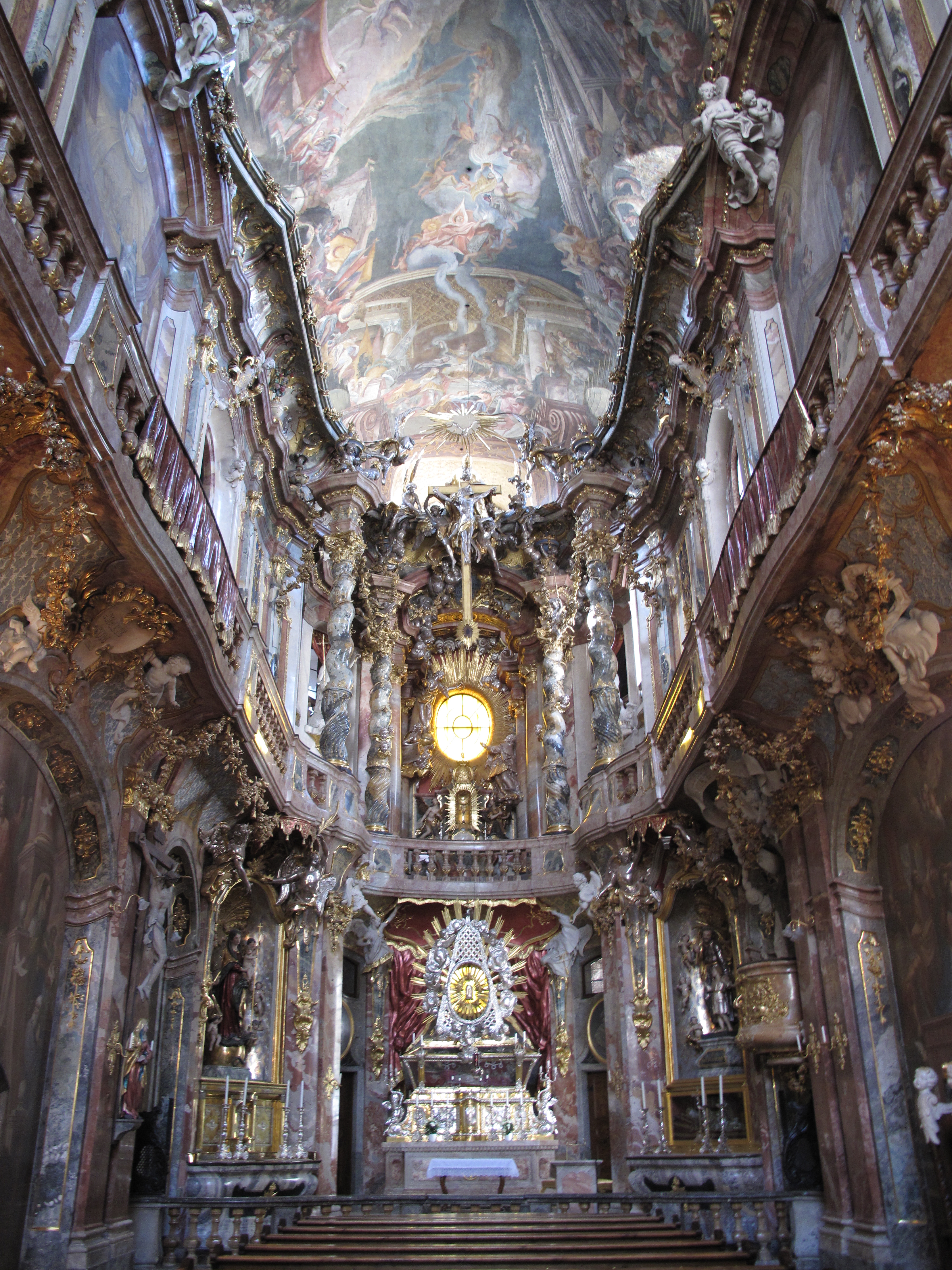 Interior of St. Johann Nepomuk (Asamkirche), Munich — Baroque detail and structure in the service of awe.
In fact, Bach's best canons use their structure to reach a poetry that could not be achieved any other way—a musical point that could only be made with a specific form. The mirror canon that closes the first half of the Goldberg Variations—the first of only three minor-key sections out of thirty total—is one such piece.
In the first voice, we get a downwards lament. The follower immediately echoes it by rising up to the heavens. And somehow the reflection gives it an entirely different meaning.
The piece ends with the voices continuing in contrary motion, separating toward opposite ends of the keyboard, as if they could go on in that direction forever. There are many things in life that this canon could be symbolic of, any number of yin-and-yang meditations it could represent. But to me, this form is such a pure statement of duality that I don't need to say it's about light and dark or life and death, just that it simply is is enough.
Holism, Reductionism, and Fugues
In listening to these examples, you likely experienced two different ways of interpreting and listening to these contrapuntal works with lots of different voices. You can either pick out and separate the individual lines, like the violin and the piano in Franck's sonata, and follow them. Or you can just hear the combined sound, like stepping back and seeing the entire cathedral.
Listening to the individual parts is called reductionism. Listening to the bigger picture is called holism. It's nearly impossible to do both at once.
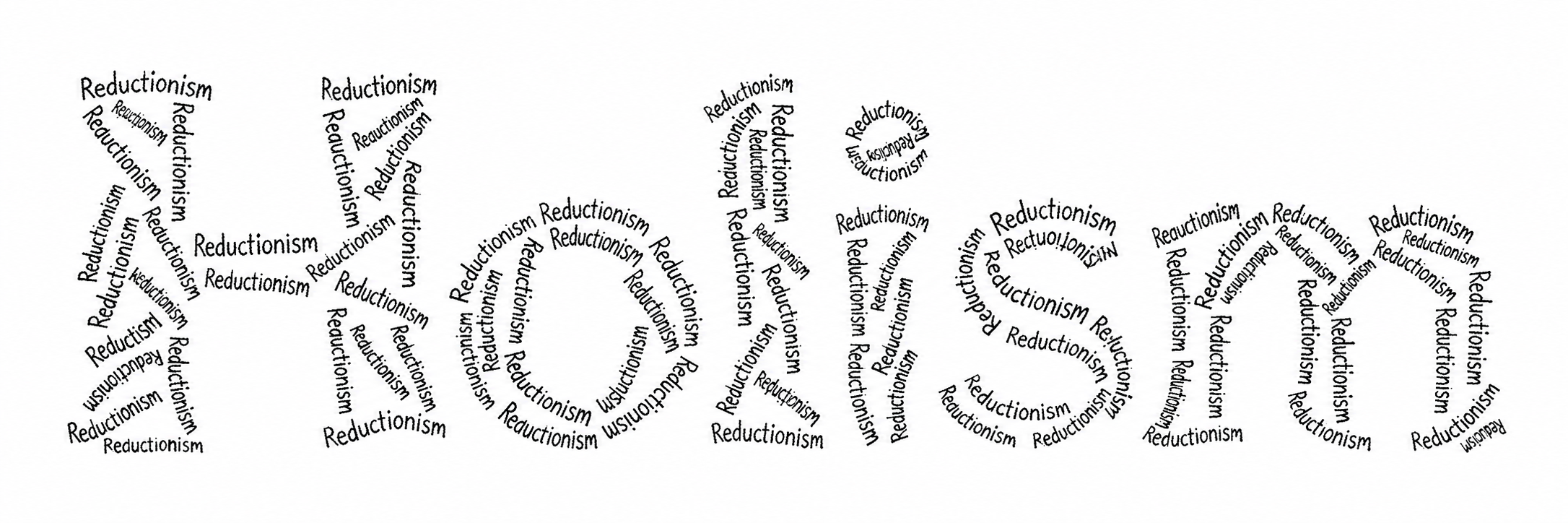 The word "Holism" formed from many smaller repetitions of the word "Reductionism." Adapted from Gödel, Escher, Bach.
Having alternate approaches is one of the reasons that classical music doesn't seem to get old as it's replayed—you can always look at it a different way and find something new.
Let's take a look at a couple fugues with this lens. A fugue's defining feature is that it has a theme (or two or three) that is passed around from voice to voice. The opening exposition often sounds just like a canon—you hear the same melody from each voice in succession—but there is much more freedom in a fugue. After a voice plays the initial theme, there are no rules about having one voice strictly following another note by note.
We'll start this time with a vocal fugue, where each musical “voice” is literally a different voice. At the beginning, it's much easier to apply a reductionist approach, listening to every voice as it enters. By the end there is so much going on that it's extremely difficult to follow the individual vocal lines, especially on a first listen.
Here is a section from the B Minor Mass, “Cum sancto spiritu” (With the Holy Spirit). Every time you hear those words, it will be a new voice entering with the fugal theme, which is called the subject.
Stretto fugues—fugues where the entrances start layering on top of each other—naturally build in tension as more voices enter. And yet the amount of “melody” is so small—just a single theme that is repeated over and over again. Another case of self-reference giving greater meaning to a work: you could never have expected the full effect of multiple overlapping fugal lines from just hearing the theme by itself.
Once you start listening for this, you can hear it in lots of places, like the opening of the Mendelssohn Octet's finale—in which all eight players, from lowest to highest, take up the fugue subject more rapidly towards the end (a mini-stretto) before regrouping in unison. This is called a fugato—a fugal section of a larger work.
Fugatos abound in the repertoire—see the Rabbit Hole at the end of the chapter—without telling you what structure they will take. I remember conducting the Barber Adagio for Strings for the first time and realizing, “wow this is just a fugue and the climax is a stretto, I had no idea.”
On the first listen, you might not even be able to tell whether something is a fugue or not, let alone hear all the entrances. Charles Rosen wrote, “A fugue of Bach can be fully understood only by the one who plays it, not only heard but felt through the muscles and nerves.” (Honestly, I'm not even sure the pianist can ever fully understand it. Bach humbles us all.)
Like the more mind-blowing canons, fugues can transform their theme in any number of ways—play it twice as fast or slow, play it upside down, backwards, both, etc. 💬
But unlike the canon, of which few were written after Bach, fugues have been written ever since, in various styles and even with new complexities.
György Ligeti, who knew Hofstadter's work, started his etude “Autumn in Warsaw” with one of the simplest themes possible—four notes falling downwards, used throughout music as a lament. He sets this against a hypnotically pulsing background that keeps the time for performer and audience: the lament theme falls down once for every five background notes.
Then, as in a fugue, Ligeti starts bringing in the theme in more voices. He's not strict about the shape of the theme being the same—sometimes the lament will be only three notes, sometimes it will be extended far beyond that. But the key is that he changes their speed every time—what started as every five beats is sometimes shortened to three or extended to as much as nine, and sometimes variable. Here it is, with some “reductionist” cues in the notes.
Sometimes this piece is called a “tempo fugue”—a fugue that is playing with time.
When I perform this piece, people often say, “that must be impossible to memorize.” In fact, the first time I performed it in a competition, I lost my fingers and had a terrible memory slip—skipping almost an entire page by the time I recovered. After the competition, one jury member, who had the score in front of her, came up to me and said, “wow, I can't believe you memorized that so well!”
This is to say—it can be virtually impossible to follow some pieces on the first listen, even if you're a professional pianist looking at the music—but the impression of all these harmonies coming together unexpectedly will always be there, even if you can't follow the specific lines.
By the ending, the holistic effect is clearly in control:
Transformations through Time: Variations
We've already seen plenty of transformations of the theme in canons and fugues, from varying the speed (called augmentation/diminution) to turning it upside down (inversion).
In a Theme and Variations, we see these devices and many more that don't even have names, but the difference is that each change gives us a different character, resulting in a full set of character pieces, not unlike those from the tone poems chapter.
Niccolò Paganini's 24th Caprice has the quintessential theme—so catchy that it's an earworm in itself—and simultaneously a simple enough cell that the possibilities are endless, regardless of the composer or the style.
The theme is so “variationable” that composers from Johannes Brahms and Franz Liszt to Andrew Lloyd Webber and Benny Goodman have written variations of their own. In 2022, violinist Fenella Humphreys even recorded 12 newly commissioned micro-variations, each just 16 bars, with subtitles ranging from Emily Howard's post-COVID Lockdown to Seonaid Aitken's Gypsy Jazz. In many ways, this idea of a single theme, or “head,” followed by conversation about the theme is the basis for jazz.
My favorite of the Paganini variations is Rachmaninoff's Rhapsody on a Theme of Paganini, which uses the exact same theme, divided between the piano and the orchestra.
Here is the 18th variation:
I had no idea what transformation Rachmaninoff was performing here for probably the first dozen times I heard the piece. The melody was too luscious to make me even ask how it was connected to the main theme—I just sort of trusted the composer that it was connected somehow.
Just as in the canons and fugues of Bach, he just took the theme and flipped it upside down:
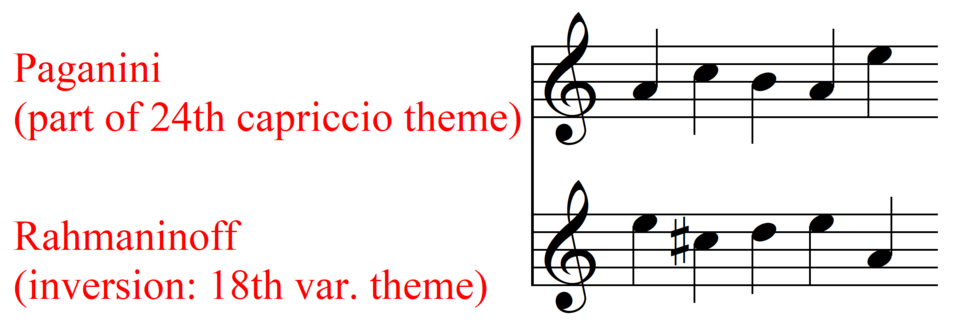 Even if you don't read music, you can tell that Paganini's theme is a mirror image of Rachmaninoff's
What's amazing is how far removed the result is from the violin's virtuoso showpiece, transformed into a sing-your-heart-out, can't-help-but-fall-in-love, soaring melody with more than a little bit of Hollywood. Commenting on this variation's appeal, Rachmaninoff said, “This one's for my agent.”
As an audience member, you never in your wildest dreams would have heard the original theme and imagined you'd end up here. Rachmaninoff did—but our primary impression isn't one of “wow he's a genius for coming up with that”; we are just swept up in the beauty of a complete transformation that we never saw coming.
Pocket Concert: The People United Will Never Be Defeated!Tap to Expand
Variation form seems to thrive on every scale. Paganini's 24th Caprice lasts just around five minutes and functions as a complete, standalone piece, while Rachmaninoff's rhapsody on the same theme lasts around twenty-five. Beethoven's Diabelli Variations clock in at around an hour, while Bach's Goldberg Variations last an hour and a half. All are undisputed members of the classical canon.
Many Stars or One Constellation
The main listening “tension” with variations is similar to that of a set of character pieces. To what extent is a set of variations one whole piece or just many parts?
Questions of this theme should be familiar by now. Of course, what holds it together is self-reference—the fact that each subsequent variation is in conversation with the theme and its previous variations.
A piece where all the variations sound too similar is just boring (whether it's the composer's fault or the performers'). If the variations are too different, it loses its sense of narrative; the listener just sees nonsensical snapshots.
In his variations on Ah, vous dirai-je, Maman, Mozart plays with this question, teasing us, enchanting us, and inadvertently showing just a bit of genius.
His theme is arguably the most recognizable tune in the Western world:
Through his variations, he stretches it to its breaking point—challenging us to find just how his variations connect back. And yet somehow it always still sounds like it's part of the same piece.
Here is pianist Elisabeth Brauss. Use the selector below to sample a few of the variations that Mozart writes.
Any of these variations by themselves would still be quite beautiful. They are fuller than a simple fugue theme. But honestly, they probably wouldn't be that notable by themselves. It is the self-reference—the way each new character joins this conversation and adds their own flavor to it—that makes Mozart's world feel richer and richer as the piece develops.
It can be a humbling experience to think for a moment what you might do if you were to craft variations of this tune, being as creative as possible to try to come up with something interesting. And it might add a little awe at the composer's genius to your response to a piece.
We began the chapter with Row Row Row Your Boat, so why not end it with Twinkle Twinkle Little Star? The present-day pianist/composer/YouTuber Hayato Sumino begins his 7 Levels of Twinkle Twinkle Little Star like Mozart, but then quickly takes off on his own, using all the styles that he has access to in the 21st century.
Again use the selector to sample the variations. Unlike Mozart, Sumino always keeps the main theme more or less unchanged, but there's so much inventiveness in the notes “around” the theme that the audience can't wait to hear what he'll do next.
Variation form has storytelling built in, not unlike a movie soundtrack which treats its main theme differently every time depending on the situation it comes back.
The next question is—what would it look like to remove the bumps in the road, and replace a set of vignettes with one long story arc instead?
In the next chapter we'll come to what many consider the peak of the classical repertoire: the sonata and the symphony.
The Rabbit HoleMy listening recommendations
There's a ton of music to recommend here, so I'll try to organize it for easy perusal.
Canons, as we discussed, sort of begin and end with the canons of Bach—the Goldbergs' Canon at the 7th is my personal favorite—but there are some others to point out as well. Schumann wrote canonic etudes for the pedal piano, a very cool piano-organ sort of a hybrid instrument.